
No matter who you talk to or where you go these days, one word dominates the conversation: AI. It is on everyone’s tongue from corporate boardrooms and tech parks to local tea stalls. Whether it is an IT professional worried about automation, a freelance creator adapting to generative tools or a child interacting with a smart device, artificial intelligence is expanding rapidly. It is making its presence felt across every age group, industry and job sector.
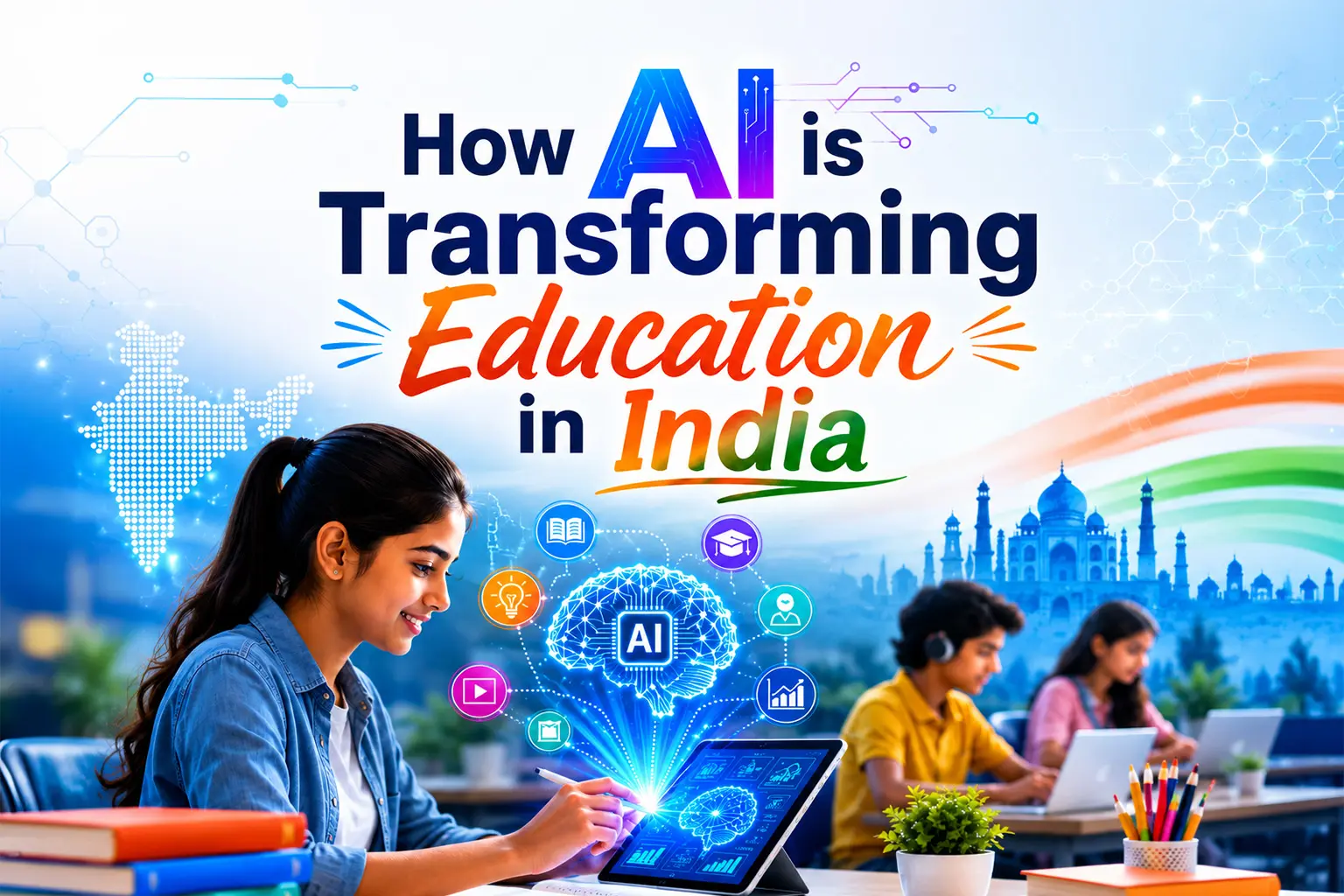
While its impact is visible everywhere, the most profound shift is happening in the way we learn. The role of artificial intelligence in education is no longer a futuristic concept discussed only in research papers; it is unfolding in classrooms right now. However, moving past the massive hype requires a serious reality check. If you read global tech headlines, you might think Indian classrooms have been replaced by virtual reality pods and independent robotic tutors. The ground reality in India is different, yet incredibly active.
India is navigating a massive educational landscape of over 250 million students. Here, the true transformation is not about replacing human contact but using technology to support overloaded teachers and provide resources to students who lack them. While elite private institutions are experimenting with advanced conversational platforms, thousands of rural schools face basic connectivity issues. The real story of how education is transforming in India lies right in the middle where practical, scalable tools are stepping in to solve age-old educational challenges.
8 Ways AI is Transforming Indian Education
1. Vernacular Translation and Local Language Access
India’s greatest strength and its biggest educational challenge is linguistic diversity. Major national initiatives are actively using machine learning models to translate complex textbooks and digital content into 22 official Indian languages. This breaks down massive language barriers, ensuring that a student in a remote village can access the exact same high-quality physics or math material as a student in a metro city, entirely in their native language.
2. Smart Classrooms and Concept Visualization
Abstract concepts in science and mathematics often lead to rote memorization. Today, AI technology in education is changing this through interactive digital boards and visual aids in schools. Instead of just reading about the human circulatory system or complex geographic landforms, students see these systems mapped out dynamically on screens. This visual approach helps students grasp complex ideas faster without added academic stress.
3. Smart Assistive Tools for Inclusive Classrooms
True inclusion means creating a learning space where differently-abled students are not left behind. Specialized tools are making remarkable progress here. Software applications featuring advanced text-to-speech, speech-to-text and image-to-text conversion allow visually or audibly impaired students to learn at their own comfortable pace. Dedicated platforms are also being used to screen for and support early-stage learning difficulties like dyslexia.
4. Reducing the Administrative Load on Teachers
A common issue in Indian schools is that teachers spend hours on routine clerical tasks instead of actual teaching. Automated administrative tools are taking over duties like tracking attendance, managing records, and processing basic grading. By handling these repetitive chores, technology allows educators to invest their time where it matters most: face-to-face interaction, mentoring, and addressing the emotional wellbeing of their students.
5. Supplemental Preparation for Competitive Exams
The reality for high schoolers in India revolves around intense board exams and competitive entrance tests. Recent surveys show that a vast number of students in higher grades use generative tools multiple times a week as a study aid. While they still rely heavily on physical books and offline coaching, they use smart search tools to clarify confusing concepts, summarize long chapters, and generate practice questions late at night when a teacher is unavailable.
6. Early Identification of Learning Gaps
In a traditional crowded classroom, a student’s confusion often goes unnoticed until the final exam report arrives. AI powered learning platforms help fix this by offering short, low-pressure digital quizzes. These tools analyze performance patterns in real-time, instantly highlighting specific topics where a student is stumbling. This gives teachers a clear roadmap of who needs immediate remedial help before gaps widen.
7. Upgraded National Curricula and Skill Modules
The Central Board of Secondary Education (CBSE) and NCERT have introduced structured AI skill modules starting as early as Class VI. This early exposure ensures that the next generation does not just view technology as a consumer product, but understands how computational thinking works. Higher technical education boards have similarly integrated machine learning fundamentals across all IT-related courses to keep up with industry demands.
8. Digital Ecosystem Integration via DIKSHA
The government’s nationwide digital infrastructure, DIKSHA, is integrating smart capabilities to serve millions of users. Features like voice-activated keyword searches within educational videos make it incredibly easy for students to find specific lesson topics instantly. This large-scale deployment proves that the impact of AI on education is expanding past private tech applications to become a core part of public education.
A New Era: Balancing Tech with the Human Touch
India currently faces a major structural gap; only a fraction of the country’s 1.5 million schools possess fully equipped computer labs. Relying blindly on digital platforms without fixing ground-level infrastructure risks widening the divide between well-funded urban schools and rural institutions.
Furthermore, smart tools are prone to factual errors and struggle with logical or numerical subjects. Students themselves note that while these tools are great for writing assistance or information retrieval, they cannot replace the judgment, empathy, and guidance of a human teacher. The future of AI in schools and colleges is not an automated screen replacing a classroom; it is an empowered teacher using a powerful tool to give every child a better chance at learning.
The shift we are witnessing across India proves that the role of artificial intelligence in education is to act as a supportive force multiplier. It helps bridge linguistic divides, simplifies administrative burdens, and makes classrooms more engaging. As the technology matures, our focus must remain on implementing it responsibly, securely, and equitably so that every student benefits.
Read more articles on Jaihind website to stay updated with the latest technological shifts and deep dives into how our nation is progressing, read more articles at jaihind website.